
A. Most sources point to the mid-1950s as the birth of rock and roll as a distinct commercial genre—roughly 1954 to 1956.
Key markers:
- 1951–1953: Early recordings blur R&B, jump blues, and country—Jackie Brenston’s “Rocket 88” (1951), often called the first rock and roll record, and Bill Haley’s early singles.
- 1954: “Rock Around the Clock” by Bill Haley & His Comets is recorded (hits big in 1955). Elvis Presley records “That’s All Right” at Sun Studio.
- 1955–1956: Elvis breaks nationally, Little Richard releases “Tutti Frutti,” Chuck Berry drops “Maybellene,” and the sound becomes a youth phenomenon.
The term “rock and roll” was popularized by DJ Alan Freed starting around 1951, but the music itself grew out of Black rhythm and blues, gospel, and country traditions throughout the late 1940s and early ’50s.
So: the sound emerged gradually, but the explosion happened between ’54 and ’56.
Was Rock around the clock was the first rock song?
Not quite. “Rock Around the Clock” was the first rock and roll song to hit number one on the pop charts (1955) and become a massive mainstream phenomenon, but it wasn’t the first rock and roll recording.
Earlier contenders include:
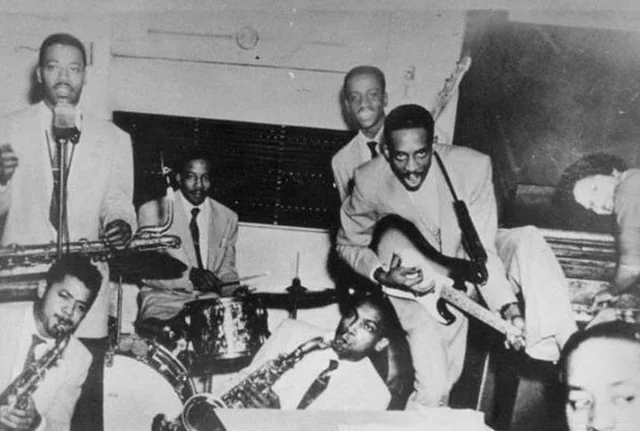
- “Rocket 88” by Jackie Brenston and his Delta Cats (1951)—often cited as the first, with a distorted guitar sound and driving rhythm.
- “Crazy Man, Crazy” by Bill Haley (1953)—his earlier hit before “Rock Around the Clock.”
- Various jump blues and R&B records from the late ’40s and early ’50s by artists like Wynonie Harris, Goree Carter, and Fats Domino that had the essential elements.
The issue is that rock and roll didn’t start with one song—it evolved from rhythm and blues, so the line is blurry. “Rock Around the Clock” is more accurately the first rock and roll smash hit that brought the sound to white mainstream America and defined the genre commercially.